
My Labs Are Normal—So Why Don’t I Feel Like Myself?

If your labs are normal but you don’t feel normal, you’re not imagining the disconnect. Maybe your energy has changed, your sleep is off, your workouts feel harder, your weight is shifting, or you simply don’t feel like yourself anymore.
So you do what you’re supposed to do. You make an appointment. You get blood work.
And then you hear:
“Everything looks normal.”
Yet you still don’t feel normal.
So what does that mean?
Normal Labs but Don’t Feel Normal? Start With the Bigger Picture
First, normal laboratory results are reassuring. They can help rule out many important medical conditions, and that matters.
But a laboratory reference range is only one piece of the clinical picture.
Numbers need context.
Your age and symptoms matter. So do your medications, menstrual cycle or hormone status, sleep, exercise habits, nutrition, stress level, body composition, medical history, and changes over time.
A single number rarely tells the entire story.
That is why I often tell my patients that we are not treating a piece of paper. We are treating the person sitting in front of us.
Midlife Changes More Than Your Birthday
For many people, the years between 40 and 60 bring changes that can feel surprisingly sudden.
Women may begin experiencing hormonal fluctuations associated with perimenopause and menopause. Men may notice changes in testosterone, body composition, energy, sleep, or recovery.
But hormones are only part of the picture.
Thyroid function, iron status, metabolic health, sleep quality, nutrition, medications, stress, muscle mass, cardiovascular health, and other factors can all influence how you feel.
Sometimes several small changes happen at the same time.
Individually, none of them look dramatic.
Together?
You feel completely different.
“I’m Doing Everything Right. Why Is My Body Changing?”
This is one of the most common frustrations I hear.
Someone has exercised for years. Their diet hasn’t dramatically changed. They are still showing up at work, taking care of their family, running their business, training, traveling, and doing all the things they’ve always done.
But suddenly they are gaining abdominal fat.
Their workouts feel harder.
Recovery takes longer.
They wake up during the night.
More caffeine starts feeling necessary just to function.
Building muscle may not come as easily as it once did.
Their cholesterol or blood sugar starts creeping in the wrong direction.
And naturally they wonder:
What am I doing wrong?
Sometimes the answer is: nothing.
Your physiology changes with age, and your strategy may need to change with it.
What worked at 30 may not be enough at 48.
That doesn’t mean you should accept feeling terrible as “just getting older.”
It means we need to understand what has changed.
Looking Beyond One Laboratory Value
Many patients come to me because their labs are normal but they don’t feel normal.
When someone tells me, “My labs were normal,” one of my first questions is:
Which labs?
Because “normal blood work” can mean very different things depending on what was actually tested.
Depending on the person’s symptoms and medical history, a more comprehensive evaluation may include looking at areas such as:
- Thyroid function
- Iron and ferritin
- Vitamin and nutrient status
- Glucose regulation and metabolic health
- Lipids and cardiovascular risk markers
- Hormones when clinically appropriate
- Inflammation and other risk markers
- Liver and kidney health
- Body composition
- Sleep quality and possible sleep disorders
Not everyone needs every test.
More testing is not automatically better medicine.
The goal is to ask the right questions and choose testing that actually helps answer them.
Women: Could This Be Perimenopause Even If My Labs Look Normal?
Absolutely worth discussing.
One of the confusing things about perimenopause is that hormone levels can fluctuate significantly. Women may still have periods—and sometimes relatively regular periods—while experiencing changes in sleep, mood, menstrual patterns, body composition, temperature regulation, libido, cognition, and energy.
That means one hormone panel cannot always explain everything a woman is experiencing.
When your labs look normal but you still don’t feel like yourself, the next step is not necessarily more testing. It is better context.
The conversation should include symptoms, menstrual history, age, health history, medications, lifestyle, and appropriate testing when indicated.
And ladies, I understand why this stage can feel confusing.
Sometimes you don’t even know whether you want to cry, sleep, eat everything in the refrigerator, or tell everyone in the house to stop breathing so loudly.
Sometimes all four. 😂
But symptoms still deserve a thoughtful evaluation instead of automatically being dismissed as “just hormones.”
Men: Is It Really Just Getting Older?
Men experience their own version of this frustration.
A man in his 40s or 50s may notice lower energy, decreased exercise performance, changes in body composition, reduced libido, poor sleep, decreased motivation, or slower recovery.
And the assumption becomes:
“You’re getting older.”
Maybe.
But age alone should not stop us from looking at sleep, metabolic health, cardiovascular risk, medications, testosterone when clinically appropriate, nutrition, alcohol intake, training, stress, and other factors that may be contributing.
The goal is not to turn every symptom into a hormone problem.
The goal is to understand the whole person.
So, if your labs are normal but you don’t feel normal, symptoms, trends, lifestyle, medications, sleep, and health history all deserve consideration.
The Bigger Question Is Not “Am I Normal?”
For high-performing people, I think there is a better question:
Am I functioning the way I want to function?
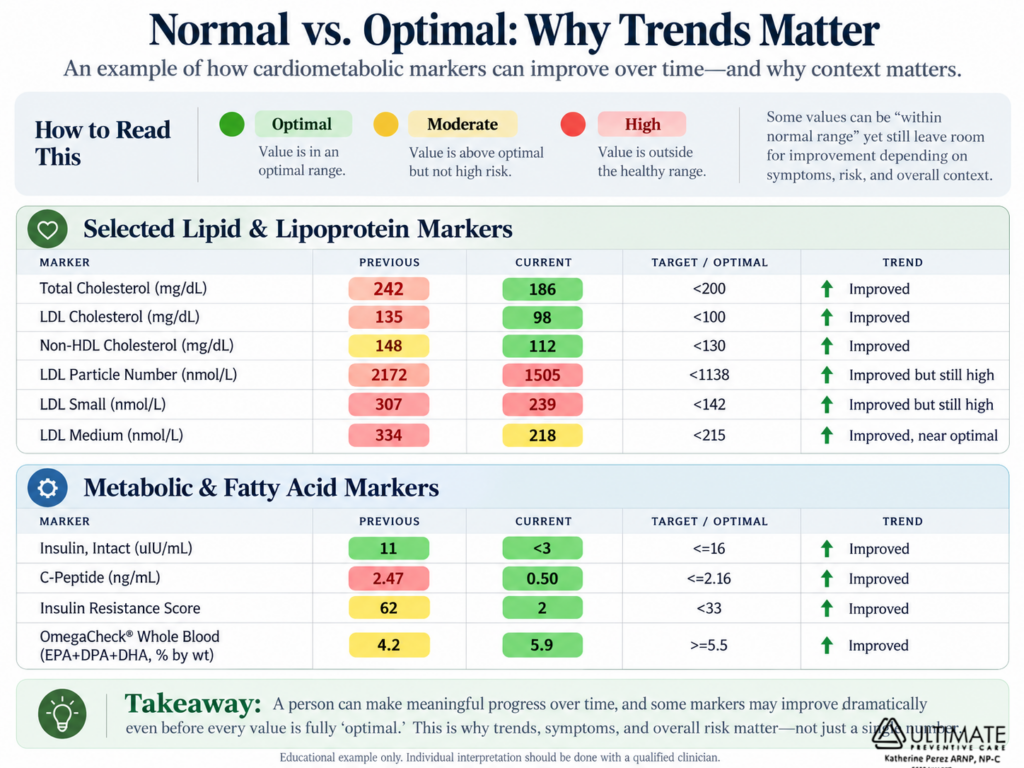
You may technically fall within a reference range and still have opportunities to improve your health.
That does not mean chasing perfect numbers.
It means understanding trends, identifying modifiable risk factors, addressing symptoms appropriately, protecting muscle and metabolic health, improving sleep and recovery, and reducing future disease risk whenever possible.
You optimize your business.
Your schedule gets optimized too.
You optimize your training.
Your health deserves that same level of attention.
What Should You Do If Your Labs are Normal but don’t feel normal??
Start by paying attention.
What changed?
When did it change?
How is your sleep?
Has your weight or body composition changed?
How are your workouts and recovery?
What is happening with your menstrual cycle?
Has your libido changed?
What medications or supplements are you taking?
How is your stress?
What does your family history look like?
And most importantly, find a healthcare professional who is willing to look at the entire picture rather than one isolated laboratory result.
Sometimes the answer is hormonal.
In other cases, it may be metabolic or thyroid-related.
Sometimes it is thyroid-related.
Sleep, nutrition, stress, medications, lifestyle, or another medical condition may also play a role.
And often, several of those factors are working together.
The goal should never be to convince you that something is wrong.
The goal is to understand why you don’t feel like yourself—and determine what, if anything, can be improved.
Because “normal” is reassuring.
But you also deserve to understand how your health fits into the life you actually want to live.
Ultimate Preventive Care Group provides personalized health optimization and preventive care for busy professionals, entrepreneurs, active adults, and high-performing individuals who want to better understand their health and take a proactive approach to aging well.
This article is for educational purposes only and is not intended to diagnose, treat, or replace individualized medical care.